
From lecture halls to office meetings
In May this year I handed in my final assignment and officially completed my undergraduate degree in Business Management and Marketing. Fast forward to today and I’m completing an internship at Kortext before heading to start my master’s degree.
One thing that’s remained constant throughout all of this has been the consistent rise of AI.
Whether I was researching assignments, managing my workload or generating ideas, AI became a tool that me and many other students used to streamline our workloads throughout the university journey.
Now, in a professional environment I’ve noticed that AI is just as present, however it’s used in many different ways – moving from university into this unfamiliar environment has given me a unique perspective on how AI can be used in both settings.
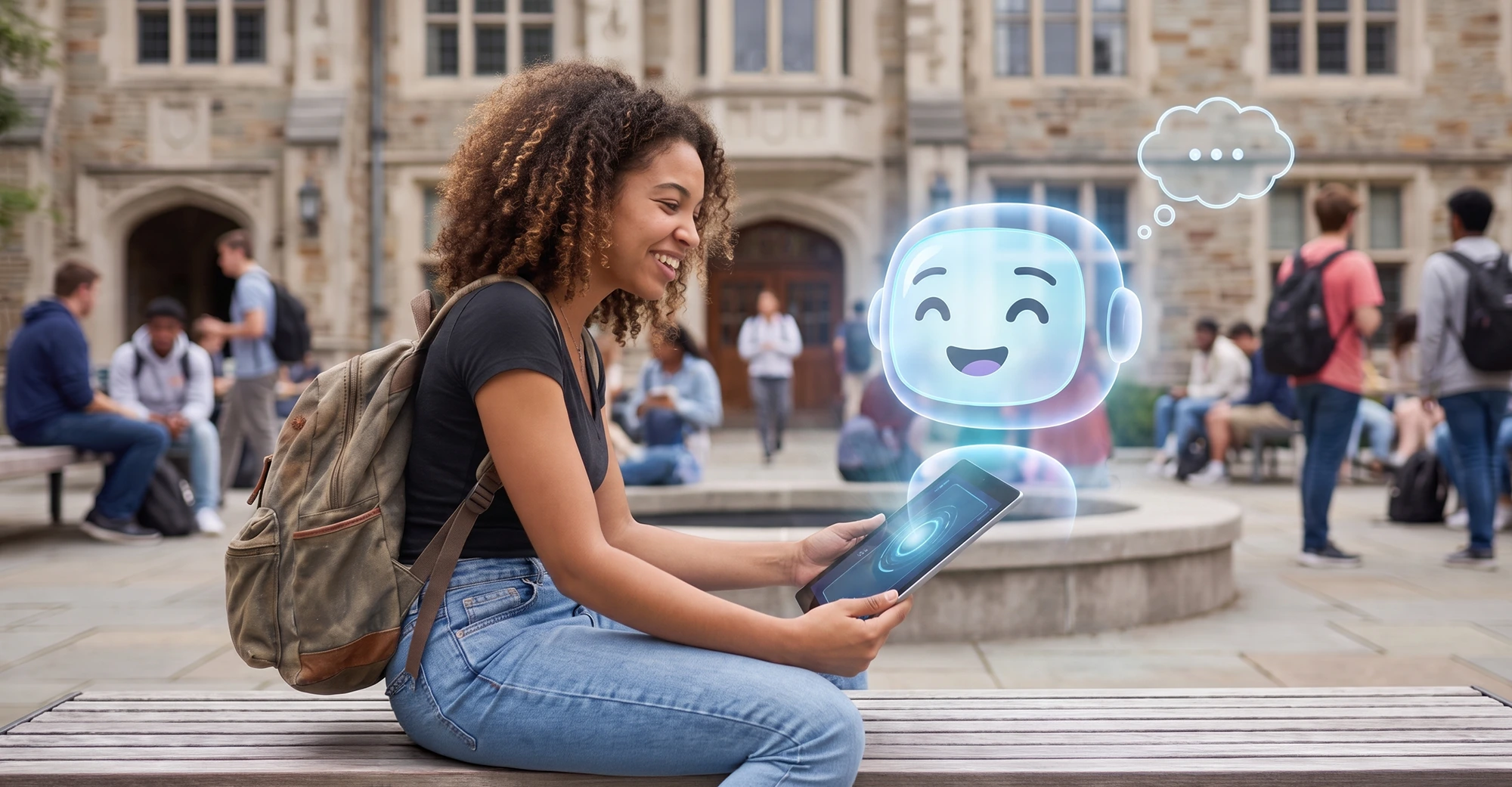
How I used AI at university
In my first year at uni, we were consistently told not to use AI. We were told that if we were caught using it, our work could end up being marked as a fail. One lecturer used to tell us two or three times each session “Do not use ChatGPT.”
However, in the following two years of my degree this all changed. My university began embracing AI instead of being afraid of it.
They began advising us to use it for tasks such as summarising sources, generating ideas, and creating revision resources and flashcards much like the AI-powered tools that Kortext provides through study+ and IQ. Towards the end of my degree, they even began to incorporate AI into the assignment briefs.
Like many other students, I first turned to AI at university when I was struggling with time management.
For me, being a student meant juggling lectures, seminars, assignments, playing sports and having a social life all at the same time and I needed something to help me balance all of this. Sometimes, the hardest part isn’t completing the work, but it’s knowing where to start. AI was a big help with this.
The students who got the most value from AI weren’t using it to do their work for them. Instead, they were using it to help them understand concepts more effectively and work smarter with their time.
Entering the workplace
When I started my internship at Kortext I assumed AI would be used in roughly the same way. However, I was soon proven wrong as I discovered that AI was much more integrated into everyday processes and team activities.
Rather than being used solely to support individual tasks, it’s used to improve workflows, enhance creativity, and help teams work more efficiently.
During my time at Kortext, I have seen AI being used to support content creation, assist with research, generate ideas for campaigns, and help people quickly process large amounts of information and data.
What stood out most to me is the difference in how AI outputs are treated. As a student, it can often be tempting to view AI as a source of answers. However, in a professional environment, AI-generated content is rarely treated as a finished product.
Instead, it serves as a starting point for people to review, challenge, and refine the outputs to ensure they are accurate, relevant, and aligned with the Kortext goals and values.
This highlighted something that I hadn’t fully appreciated during my studies: the importance of human judgement. The people getting the most value from AI weren’t simply accepting whatever it produced. They were asking better questions, providing more detailed prompts, and using their own expertise to improve the final answers.
I also noticed that conversations about AI were far more collaborative than they had been at university. Colleagues would discuss different tools and share successful prompting techniques. Rather than replacing human skills, AI is used to complement them and allow people to focus on and produce higher-value work.
Final Thoughts
Having experienced AI in both a university and workplace environment, I’ve come to appreciate how differently the technology can be used depending on the situation.
At university, AI helped me learn more effectively, manage competing priorities, and make sense of large amounts of information. It became a useful study companion that supported my academic development without replacing the need for independent thinking.
In the workplace, AI has a broader purpose. It supports collaboration, creativity, efficiency, and innovation across teams and departments. While the tools themselves may be similar, the objectives are very different. Instead of helping one person complete an assignment, AI is helping organisations improve processes and create better outcomes.
Despite these differences, one lesson remains consistent across both experiences: AI is most valuable when it is used as an assistant rather than a replacement. Whether you’re a student preparing for an exam or a professional working on a business project, the technology works best when combined with your own expertise and critical thinking.
As I prepare to start my master’s degree, I’ll be taking both perspectives with me. My experience at university showed me how AI can support learning, while my time at Kortext demonstrated its potential in the professional world.
Together, they have given me a much broader understanding of how AI can be used responsibly, effectively, and productively in different environments and stages of life.