

Key takeaways from the spring library webinar 2026: responsible AI in academic libraries
We were lucky to be joined by panellists from five different institutions in our April 24 library webinar, including:
- David Clover, Director of Library Services and Digital Skills, Middlesex University
- James Anthony Edwards, University Librarian and Assistant Director of Outcomes and Skills, University of Exeter
- Davina Omar, Director of Library Services, University of West London
- Eleanora Gandolfi, Associate Director of Research Innovation, University of Surrey
- Leo Prince, Senior Digital Learning Technologist, Saïd Business School, University of Oxford
Across the 90 minutes our panellists each outlined how they were embracing AI in their libraries, with 3 key themes emerging in the race to keep up with student usage.
1. Libraries are central to appropriate use of AI
Libraries embody a sense of trust in an institution. It’s where students find their provided learning content, ask for advice and receive workshops. That’s why libraries sit at the heart of an AI-enabled learning experience – because they bring trusted, curated content into the spaces students actually use to learn.
Panellist Leo Prince points out, “we need to think about how people are really using AI, and a lot of the time people are using it very transactionally. They’re asking for stuff and getting stuff back – they’re not necessarily assessing it.”
For this reason, panellists reinforced the point that libraries lead the way in AI policy making at their institutions, as Davina Omar puts it, “from our perspective, it all centres on what we’ve been doing for years in information literacy.”
For years, the library has been teaching students how to:
– Build on the work of others
– Understand bias
– Understand inequalities in information production
– Understand author knowledge
– Find different viewpoints
As a result, many institutions look to the libraries to provide guidance on how these topics relate to AI and what that means for student assessment and learning.
2. AI means reshaping library workflows – integration is critical
When it comes to AI, students will default to the easiest pathway. With the initial release of generative AI, students were forced to go outside of their institutional systems to access the new technology.
The challenge for libraries now is to break that cycle by embedding themselves into this pathway, educating students and encouraging the transition from shadow AI use to institution-endorsed AI tools that students can trust and use with confidence, without fear of academic penalty.
As James Anthony Edwards points out: “The question for us now is ‘what tools do we provide?’ Because when we provide the tool, not only are we giving them access to something, we’re effectively saying ‘this is okay.’”
Integrating AI doesn’t just mean serving students – but staff too. “What we’re actually trying to do is shift the focus not only to the students, but how do we support our staff,” Eleanora Gandolfi explains. “Our colleagues can (use AI to) navigate the huge amount of content that is out there in a way that is easy to digest.”
This reflects a structural change. Libraries are no longer just managing collections but orchestrating connected ecosystems across VLEs, discovery tools and AI providers.
As James Anthony Edwards concludes, “it’s about providing trusted tools to people in the place they want them, to integrate with what they’re already doing.”
3. Trusted AI relies on accurate, approved data
As the panellists discussed, trust is a huge factor in partnering with AI providers. For James Anthony Edwards, this means “providing the tool that brings together content and gives students something they can work with, where the university have control over the IP.”
Leo Prince echoes this what ‘trusted AI’ means for Oxford Saïd:
“We want students to be able to access the content that is specific to their course without getting the hallucinations from going out into the internet and pulling from those areas. We want something a bit more specific, that’s going to help develop their skills, allow them to be able to trust the responses, but also being able to question and challenge and dive deeper.”
This is where the aggregation piece comes in, for AI responses to be relevant for the student, it’s crucial that AI have holistic access to the same digital learning ecosystem as the student – eBooks, VLE pages, lecture slides, study notes, etc. without drawing from unverified sources published on the wider internet.
Moreover, it’s crucial that students know how to and can validate this content, that the AI references which resource it’s drawing from, and that students know to evaluate responses using the same information literacy skills as Davina Omar outlines in the first point.
The 2026 approach: from ‘if’ AI to ‘which’ AI
Overwhelmingly, the discussion reinforced the direction of AI in the library, as not about resisting change but shaping it.
As AI becomes more embedded in workflows across institutions, the role of the library is the same as it’s always been – a mentor of information literacy and a curator of reliable resources.
Heading into the second half of 2026, the focus is shifting toward building trust, partnerships, and curiosity with AI collaborators – and we’re excited to see where this emerging approach takes the sector.
Find out how educators are tackling the AI transition in our latest white paper in partnership with Wonkhe, Educating the AI generation.
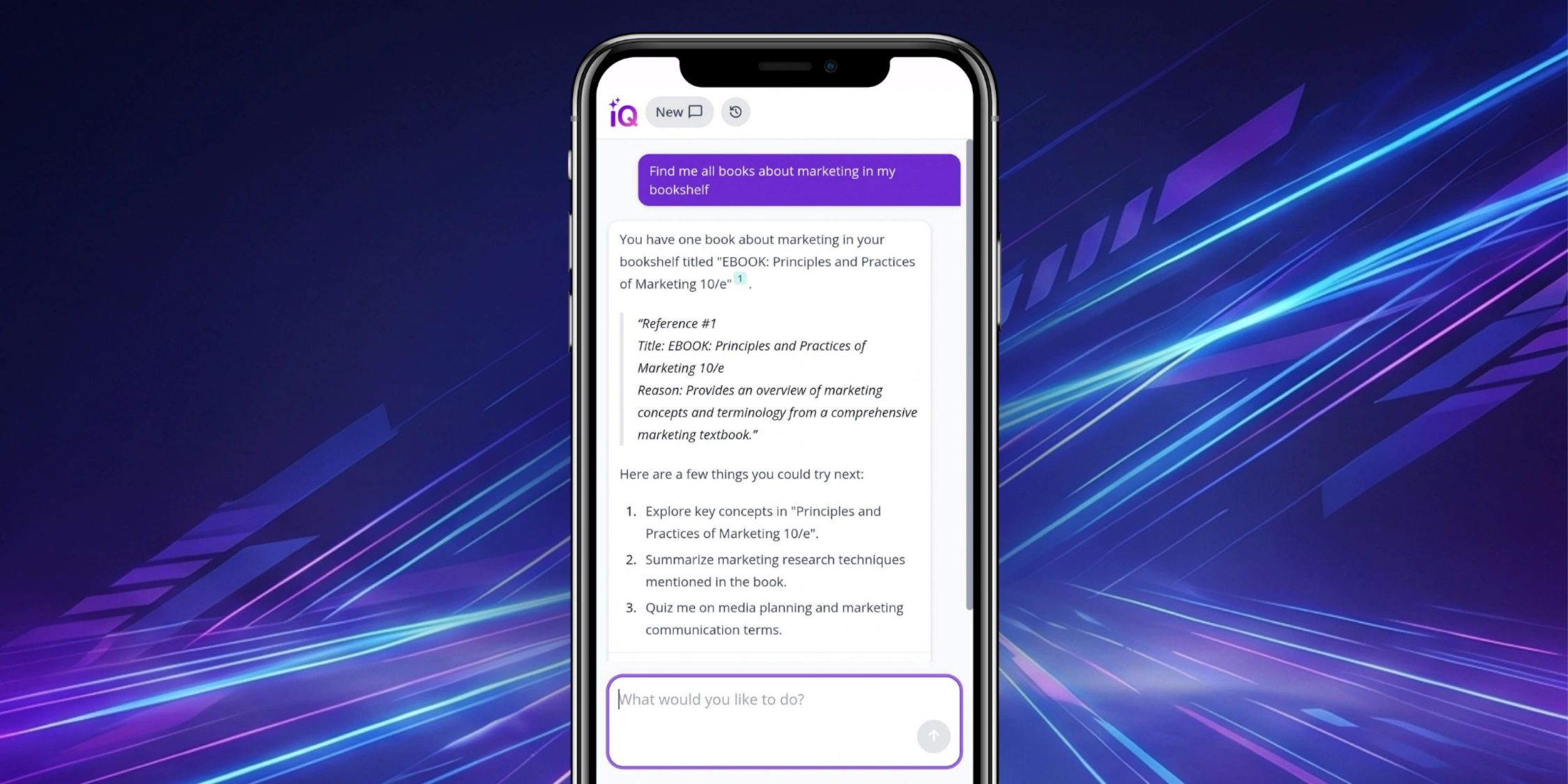
Discover more about our latest integrated AI solution, Kortext IQ.