

World Philosophy Day 2026 – an open access collection
Philosophy covers a wide range of subjects, from how ancient thinkers understood the world around them to how we make sense of new scientific and technological developments today.
To mark World Philosophy Day 2026, we’ve curated an open access collection bringing together different traditions and approaches, and selected five titles to explore in more detail.
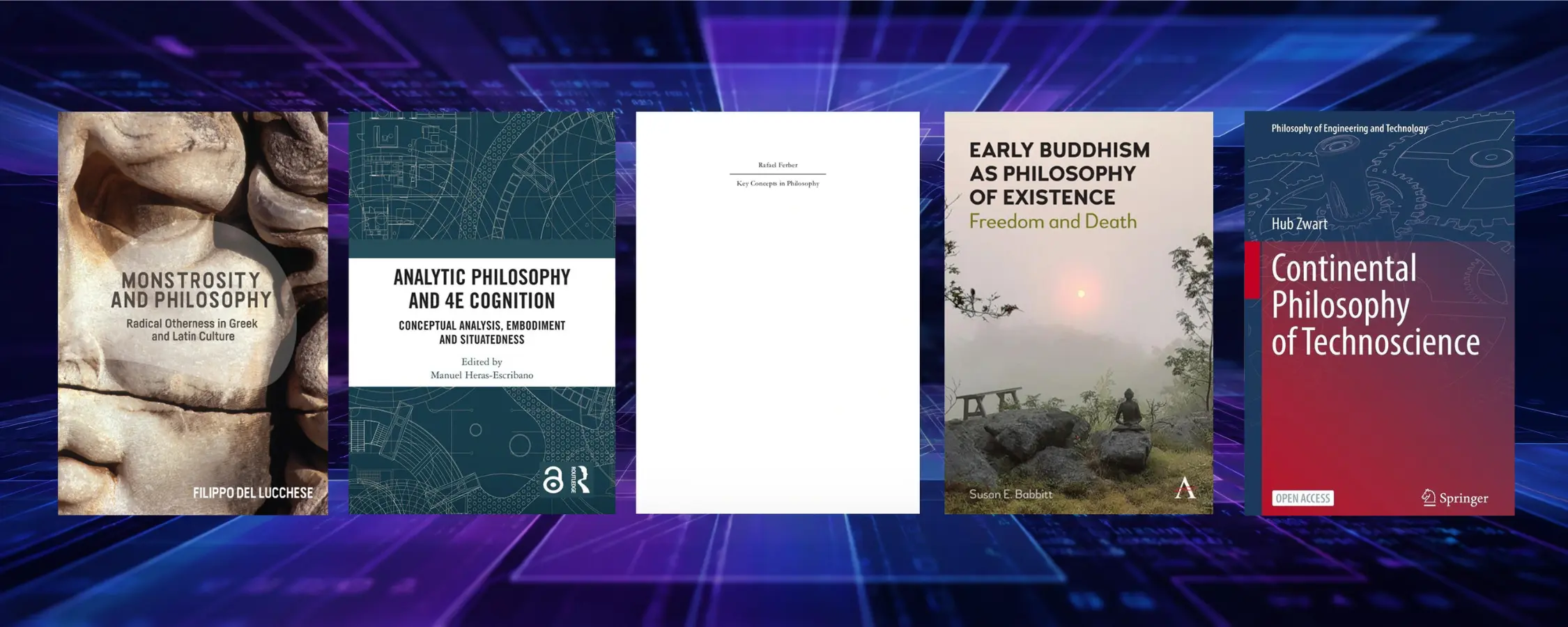
1. Key Concepts in Philosophy: An Introduction by Rafael Ferber
Ferber builds this introduction to philosophy around six concepts: philosophy itself, language, knowledge, truth, being and the good. Written for students and general readers, it sets out to draw them into the process of philosophical thinking in a clear and engaging style, while still offering new ideas for specialists.
2. Early Buddhism as Philosophy of Existence: Freedom and Death by Susan E. Babbitt
Babbitt reads the Buddha as an empirical thinker who built his philosophy of existence from careful study of the world. Focusing on freedom and death, she finds that view overlapping with Marx’s and shared by writers including Dostoevsky, Proust and Victor Hugo. Death runs through all of these views, she argues, yet they are rarely recognised as philosophy.
3. Monstrosity and Philosophy: Radical Otherness in Greek and Latin Culture by Filippo Del Lucchese
Ancient writers filled their world with monsters, and Del Lucchese treats them as a way into philosophy itself. Giants, gorgons and centaurs become test cases for how Greek and Roman thinkers understood nature and order. Tracing ideas about monstrosity from the pre-Platonic thinkers through to early Christian thought, the book examines how traditions responded to radical otherness.
4. Analytic Philosophy and 4E Cognition: Conceptual Analysis, Embodiment, and Situatedness by Manuel Heras-Escribano (ed.)
What does the body have to do with thinking? This collection puts analytic philosophy in conversation with approaches that tie the mind to the body and its surroundings, exploring where the two overlap and where tensions arise. The essays take up habit, skilful coping and consciousness, and ask what situated thinking means for society and politics.
5. Continental Philosophy of Technoscience by Hub Zwart
In this book, genomics, synthetic biology and global ecology meet philosophers Hegel, Heidegger and Lacan. Zwart’s aim is to equip students and early-stage researchers to work as philosophers in technoscientific settings. The continental perspectives he draws on are often underrepresented in mainstream philosophy of science, yet have much to say about how science and technology are developing worldwide.
Explore the full collection
These five titles offer a starting point for exploring the full philosophy collection, with further open access research available across a range of subjects and disciplines.
The themed collection forms part of the wider Kortext Open Resources Collection, which brings together thousands of open access titles.
Existing Kortext customers can contact their Account Manager to access the full collection. If you’re new to Kortext, talk to us to find out more.