
Kortext Open Resources Collection: what the data tells us
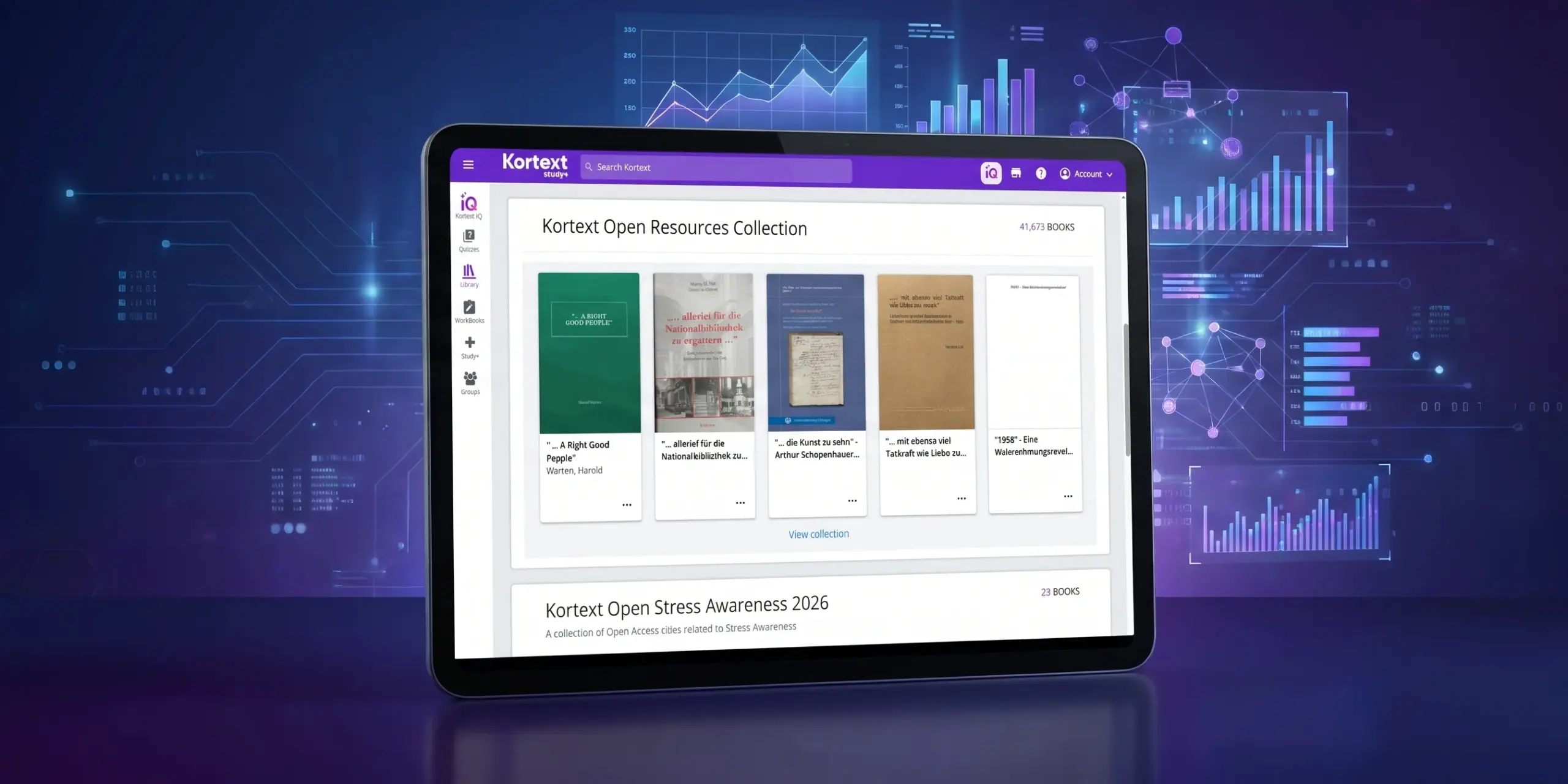
The Kortext Open Resources Collection (KORC) brings together thousands of openly available academic resources in a single, searchable platform – helping students discover content that complements their course materials.
Open resources are playing an increasingly prominent role in academic libraries. Our Annual Librarian Survey 2026 found that 57.8% of respondents said open access (OA) and Open Educational Resources (OER) had become more important at their library over the past 12 months.
But what does that mean in practice for students? Here’s a look through our 2025/26 data and what it tells us about how students used the collection, from subject interest to content engagement.
A collection that continues to grow
KORC now holds 44,228 titles, up from 37,252 last year. That’s almost 7,000 new titles and a 19% increase in 12 months. Since 2023/24, the collection has nearly tripled in size.
Growth matters because it broadens the range of content students can explore. As the collection develops, students are able to discover materials that enrich their studies, support independent learning and provide additional context around the topics they are studying.
Engagement beyond access
Almost 27,000 active users accessed the collection in 2025/26, up 8% on last year, and together they spent more than 7,700 hours studying.
| 2024/25 | 2025/26 | Change | % Change | |
|---|---|---|---|---|
| Books in KORC | 37,252 | 44,228 | +6,976 | +18.7% |
| Active users | 24,945 | 26,992 | +2,047 | +8.2% |
| Study time (hours) | 7,380 | 7,763 | +383 | +5.2% |
| Study sessions | 56,122 | 58,144 | +2,022 | +3.6% |
| Prints | 482 | 710 | +228 | +47.3% |
| Copies | 11,705 | 12,771 | +1,066 | +9.1% |
| Pages accessed | 995,127 | 939,784 | −55,343 | −5.6% |
| Annotations | 14,907 | 14,578 | −329 | −2.2% |
| Downloads | 19,062 | 17,874 | −1,188 | −6.2% |
Although the data cannot tell us exactly why students access a title, it does point to a shift in how students may be using open resources.
While the number of active users, study sessions and overall study time increased, students accessed fewer pages and made fewer downloads. At the same time, copying and printing increased.
Taken together, this could suggest more focused engagement, with students spending less time browsing and instead accessing and extracting the content they need.
What students are reading
This year’s top title reached almost twice as many students as last year’s. “… A Right Good People” by Harold Warren (Appalachian State University) was used by 1,810 students, who accessed 13,675 pages between them.
Other standouts from the top ten included:
- Organic Chemistry: A Tenth Edition by John McMurry (OpenStax): 134 hours of study time from just 82 users.
- The Mediterranean Way of Eating by John J.B. Anderson and Marilyn C. Sparling (Taylor & Francis): 517 annotations.
- Anatomy & Physiology by J. Gordon Betts et al. (OpenStax): in the top ten for the second year running.
Health and life sciences led the way, with four of the top ten titles. The rest ranged from climate science and AI in business to chemistry, peer learning and US history.
Key takeaways
Looking across the year’s activity, three themes emerge:
1. Students continue to make use of a broad range of academic resources beyond their core course materials. With more users and more study time than last year, there’s a clear appetite for supplementary content that supports learning and exploration.
2. How students engage with open resources may be changing. Downloads fell this year, while study time, printing and copying increased. This could point to more focused engagement with the content they find.
3. The data reinforces the value of bringing diverse academic resources together in one place. When content is easy to discover and straightforward to access, students are more likely to use it throughout their studies.
Looking ahead
This year’s data offers another snapshot of how students are using KORC. Usage patterns will continue to evolve, but the findings show the important role KORC plays in helping students discover and engage with a wider range of academic resources.
As the collection grows, we look forward to seeing that role develop further.
Log in and explore the Kortext Open Resources Collection or revisit our 2025 and 2024 annual updates to see how the collection has evolved over time.